
Result story
Five markets served from one product and recipe website
HAK wanted the Annabel brand to reach consumers across several European markets without maintaining a separate platform for every country. RUUB kept one multilingual product and recipe website manageable and connected each market to the relevant local Amazon destination.
- One website supported five priority markets and their language variants.
- Product and recipe pages routed visitors to the relevant local Amazon destination.
- The defensible result is the working international journey, not attributed sales uplift.
The story
The situation required more than translating the same page five times. The Annabel website combined product information with recipes showing consumers how the products could be used. That content had to remain recognisable as one brand experience while language, navigation and sales destination varied by market. At the same time, the team needed to maintain changes on one coherent platform. Five separate websites would have fragmented the same information, imagery and recipes and increased the chance of markets drifting apart.
RUUB therefore organised one shared website for the five priority markets: United Kingdom, Germany, Spain, France and Italy. Each market received its own language journey with local navigation, product descriptions and recipes. The shared structure kept recurring elements together while allowing market-focused content to be adjusted separately. A visitor could move between English, Deutsch, Español, Français and Italiano inside the same brand and product environment instead of being sent to a disconnected country website. New recipes and product updates could therefore be managed within the same structure without losing the market-specific navigation or local destination. This kept future expansion clearer for the team behind the website.
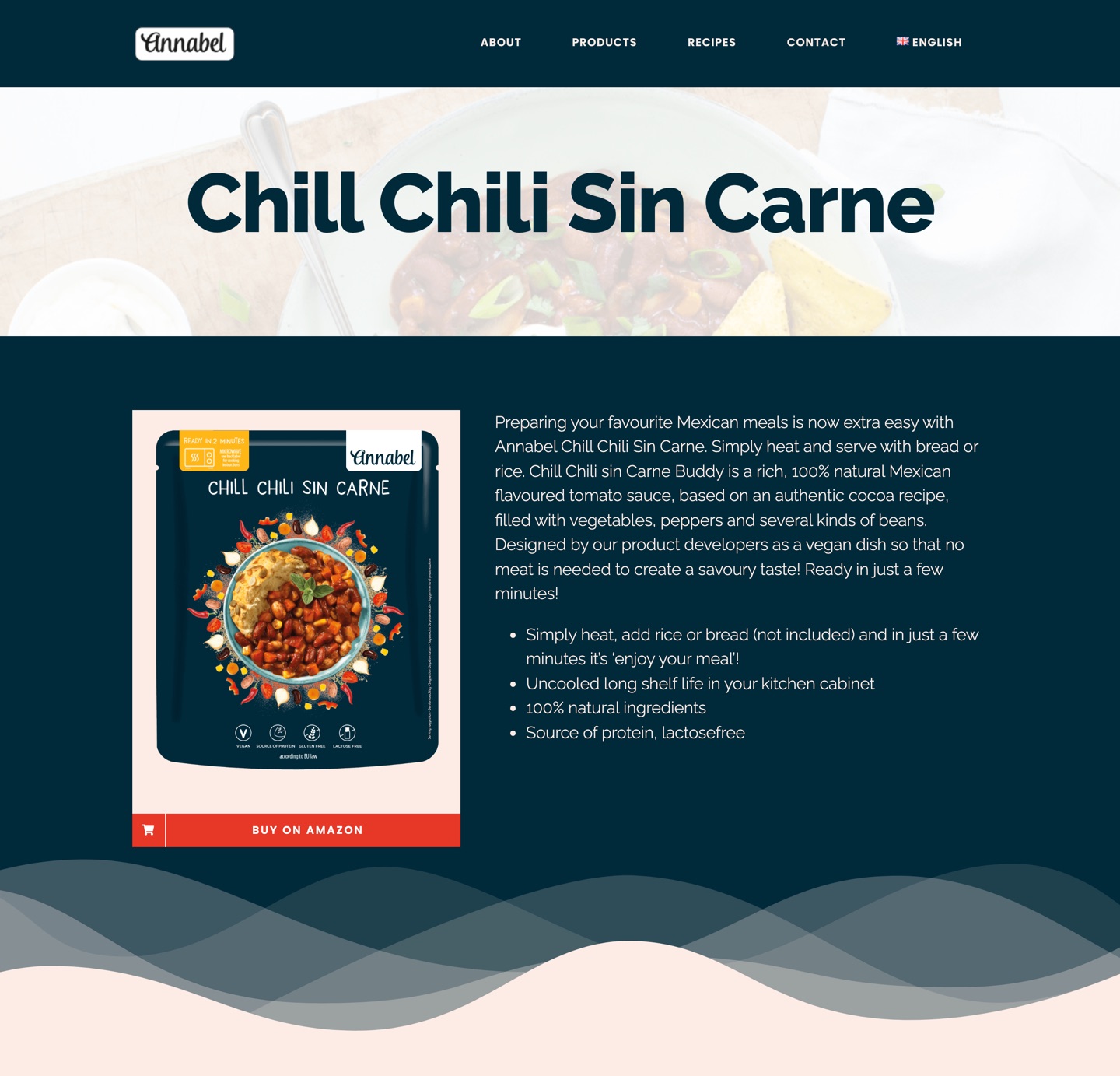
The observed result was one maintained product and recipe website with five public language journeys and five local sales routes. The approved screenshot shows the English “Chill Chili Sin Carne” page: the Annabel identity, product pack and description, language switcher and red “Buy on Amazon” action appear together in the delivered design. It provides first-hand visual evidence of how brand story, usage inspiration, language choice and onward routing were connected in one customer journey. HAK and Annabel are named only within the confirmed publication permission.
What the delivered website demonstrably supported
- Priority markets
- 5
- Local Amazon routes
- 5
The boundary
The delivered routes and screenshot support that the platform served the five markets and their local Amazon destinations. There is no reliable baseline, transaction dataset or controlled comparison that attributes commercial impact to the website. RUUB therefore claims no sales, conversion or revenue uplift from this multilingual routing. The defensible result is more concrete: one manageable website served five market-specific customer journeys and brought visitors as far as the correct external sales channel.
Questions
Can you take over an existing multilingual website?
Yes. RUUB first maps the current structure, content, language routes and integrations, then determines what can stay and what needs to be renewed in a controlled way.
Does every market need the same content?
No. A shared foundation keeps the brand and management together, while product information, recipes and actions can differ by market where needed.
Can local sales channels change later?
Yes. Destinations are managed per market, so a local sales channel can be changed later without rebuilding the entire website.
Does one website need to serve several markets clearly?
Describe which content the markets share, what differs locally and which channels visitors should reach. RUUB will help shape a manageable international structure.
info@ruub.eu